The Handwriting vs. Typing Debate Has a More Complicated Answer Than Your Professor Told You
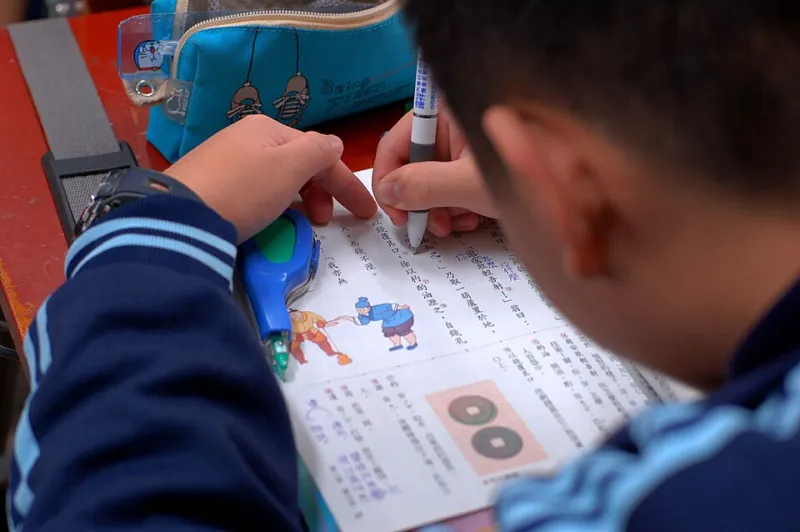
Photo: chia ying Yang, CC BY 2.0, via Wikimedia Commons
The Pen-and-Paper Narrative Took Over Classrooms
For years, the message from educators and productivity experts has been consistent: put down the laptop and pick up a pen. Handwriting is better for memory, better for learning, better for your brain. The advice spread through college orientation sessions, parenting blogs, and op-eds about tech-distracted students until it became one of those things that just feels obviously true.
The science behind it seemed solid enough. A widely cited 2014 study by Pam Mueller and Daniel Oppenheimer found that students who took notes by hand performed better on conceptual questions than those who typed. The researchers' explanation was intuitive — because handwriting is slower, students are forced to process and summarize information rather than transcribe it verbatim. The mental effort of condensing ideas was thought to be the mechanism behind better retention.
But science doesn't stay still. And in the years since that study became shorthand for "laptops are ruining students," a more complicated picture has emerged.
What More Recent Research Actually Shows
The Mueller and Oppenheimer study was influential, but it had limitations that often got lost in translation. It was conducted in controlled lab settings, used relatively short lectures, and tested recall shortly after the note-taking session. Real learning environments are messier than that.
A 2023 replication study published in PNAS — one of the most rigorous attempts to reproduce the original findings — found something unexpected: when the conditions were carefully controlled, the difference between handwriting and typing largely disappeared. Students who typed their notes performed comparably to those who wrote by hand, provided they weren't simply transcribing everything word-for-word.
That last part turns out to be the key variable. The problem was never really the medium — it was the behavior. Laptop note-takers in the original study tended to type more words and rely on near-verbatim transcription. Handwriters couldn't keep up, so they were forced to think about what to write down. The cognitive benefit came from the selective processing, not from the physical act of forming letters.
In other words, the pen wasn't the hero. The constraint was.
What Brain Imaging Studies Contribute
Neuroscientists have also looked at this question from a different angle — examining what actually happens in the brain during handwriting versus typing. Studies using functional MRI have shown that forming letters by hand activates a broader network of brain regions, including areas associated with reading and language processing. That's a real finding and it's interesting.
But activation isn't the same as retention, and retention isn't the same as learning. A brain region lighting up during a task doesn't automatically translate into better long-term memory for the content of a lecture. The research on neural activation during handwriting is often used to imply more than it actually demonstrates.
What neuroscientists are more cautious about is the leap from "handwriting activates interesting brain regions" to "therefore everyone should take notes by hand." That's a bigger claim than the data supports.
The Laptop Advantage Nobody Talks About
Here's where the narrative gets genuinely interesting: laptops have a meaningful advantage that almost never comes up in the handwriting-is-better conversation.
Digital notes are searchable, reorganizable, linkable, and shareable in ways that handwritten notes simply aren't. For long-term learning — the kind that happens over weeks and months rather than in the hour after a lecture — being able to revisit, reorganize, and connect notes across different sessions may matter more than the method used to record them in the first place.
Spaced repetition, one of the most evidence-backed learning strategies in cognitive psychology, works far more efficiently with digital notes. You can sort, tag, and resurface information at precisely the intervals that reinforce long-term memory. A notebook in a backpack doesn't do that.
The comparison between handwriting and typing has largely been evaluated on short-term recall in controlled settings. The longer-term learning picture — which is arguably what education is actually for — looks different.
Why the Myth Feels So True
There are a few reasons the "handwriting is better" belief has proven so durable.
One is that it feels true in the moment. Writing by hand requires more effort, and effortful tasks tend to feel more productive. The psychological experience of working harder maps onto the assumption that you're learning more, even when the outcome data doesn't consistently confirm it.
Another reason is that the original study got enormous media coverage while the more nuanced follow-up research received far less attention. A 2014 finding that confirmed what many educators already believed was an easy, satisfying story. A 2023 replication that complicated it was a harder sell.
There's also a broader cultural suspicion of technology in educational settings that made the handwriting narrative appealing to many teachers and parents. Laptops are associated with distraction — social media, notifications, browsing — and that association gets conflated with the question of whether typing is an inferior way to encode information. They're related issues, but they're not the same issue.
The More Honest Takeaway
The real answer to the handwriting-versus-typing question is frustratingly unsatisfying: it depends, and it depends on factors that have more to do with how you take notes than what you take them with.
Handwriting may encourage more selective processing in students who would otherwise default to transcribing everything. For those students, the constraint is genuinely useful. But a disciplined laptop note-taker who summarizes in their own words and regularly reviews and reorganizes their notes is not at a cognitive disadvantage — and may actually have the edge over the long term.
The pen isn't magic. Neither is the keyboard. The thinking you do with either one is what matters.