One of America's Most Repeated Sayings Gets Lightning Completely Backwards
A Saying That Sounds Like Science
Some phrases lodge themselves so deeply in everyday speech that they stop feeling like opinions and start feeling like facts. "Lightning never strikes the same place twice" is one of the best examples in American culture. It gets invoked at baseball games when a team blows a lead, in business meetings when someone warns against repeating a mistake, and in casual conversation as a kind of folk wisdom about probability and fate.
The only real problem with it is that it describes lightning behavior in almost exactly the opposite way lightning actually behaves.
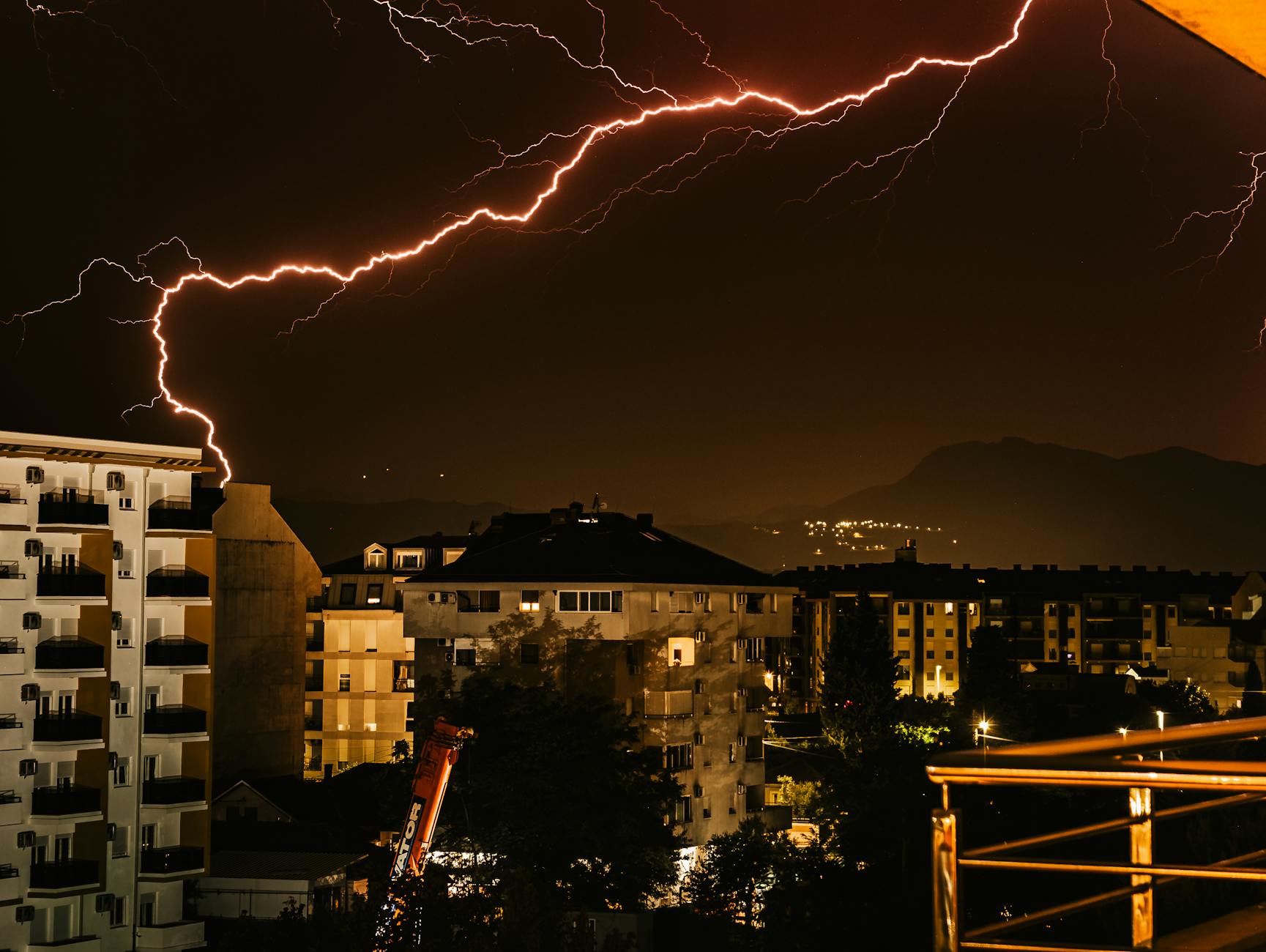
This isn't a minor technical quibble. The Empire State Building in New York City — one of the most recognizable structures in the country — gets struck by lightning roughly 20 to 25 times per year. The same building. The same antenna. Over and over. And the physics of why that happens are actually pretty straightforward once you look at them.
What Lightning Is Actually Doing
To understand why lightning repeatedly targets the same spots, it helps to understand what lightning is looking for in the first place.
A lightning bolt is essentially a massive electrical discharge — a rapid equalization of charge between a storm cloud and the ground (or between clouds). As a thunderstorm builds, negative charges accumulate at the base of the cloud. The ground below responds by concentrating positive charges, particularly at elevated points: trees, towers, rooftops, antennas.
When the charge difference becomes large enough, the air between them — normally an insulator — breaks down. A channel of ionized air called a stepped leader reaches down from the cloud, often branching in multiple directions. The moment it connects with a return stroke rising from the ground, the visible lightning bolt occurs.
Here's the key part: that stepped leader is not random. It follows the path of least resistance toward the strongest concentration of opposite charge. Tall, pointed, conductive structures are almost magnetically attractive to it — not by accident, but by physics. The Empire State Building isn't getting struck repeatedly because it's unlucky. It's getting struck repeatedly because it's exactly the kind of structure lightning is drawn to, every single time conditions are right.
Lightning rods work on exactly this principle. They don't repel lightning — they invite it to a controlled point and safely channel it to the ground. Ben Franklin understood this in the 1750s. The idea that lightning avoids places it has already hit is the opposite of how the technology he invented actually functions.
Where the Saying Came From
So how did a statement this factually backwards get so thoroughly embedded in American speech?
The phrase almost certainly started as a metaphor, not a meteorological claim. In 19th century writing, "lightning" was frequently used as a stand-in for sudden disaster, extraordinary luck, or once-in-a-lifetime events. Saying lightning doesn't strike the same place twice was a way of expressing that a particular stroke of fortune — or misfortune — was unlikely to repeat. It was a rhetorical device about probability and fate, not a description of electrical storms.
Over time, as the phrase was repeated across generations, the metaphorical origin faded. People began treating it as an observation about actual lightning. It found its way into casual conversation as received wisdom, and because most people don't spend a lot of time thinking carefully about how lightning works, the error was never obvious enough to correct itself.
This is a pattern that shows up repeatedly in popular belief: a figurative expression gets repeated literally, and because it sounds plausible — lightning does seem random and unpredictable — nobody pushes back.
Other Weather Beliefs That Don't Hold Up
Lightning isn't the only area where popular weather wisdom has quietly drifted away from reality.
"You can tell the temperature by counting cricket chirps." This one is actually more accurate than it sounds — there's a real relationship between cricket chirp rate and ambient temperature (Dolbear's Law, if you want to look it up). But the specific formulas that circulate online vary widely in accuracy depending on the cricket species involved. Points for effort, though.
"Red sky at morning, sailor's warning." This old maritime saying has more meteorological validity than most weather folklore — a red morning sky can indicate moisture in the atmosphere moving in from the west. It's not reliable enough to plan around, but it's not baseless either.
"Heat lightning is its own kind of lightning." Many Americans grew up believing that the silent flashes visible on hot summer nights were a separate phenomenon called "heat lightning" — a product of the heat itself rather than a storm. In reality, it's ordinary lightning from a distant thunderstorm, too far away for the sound to carry. There is no special category of lightning generated by heat alone.
"You're safe from lightning in a car because of rubber tires." The rubber tires have nothing to do with it. Cars actually do provide reasonable protection during a lightning storm, but because the metal frame acts as a Faraday cage — channeling the electrical charge around the outside of the vehicle — not because the tires insulate you from the ground.
Why Catchy Phrases Win Over Complicated Truths
The lightning myth is a useful lens for understanding how misinformation spreads even when nobody is trying to deceive anyone. Sayings like "lightning never strikes the same place twice" survive not because they're true but because they're useful — as metaphors, as rhetorical shorthand, as memorable phrases that carry emotional meaning.
The brain is wired to hold onto things that are simple, rhythmic, and emotionally resonant. "Lightning never strikes the same place twice" checks all those boxes. The actual physics of stepped leaders and charge differentials do not. So the catchy version wins, gets repeated, and eventually stops being questioned.
This is worth keeping in mind the next time a piece of conventional wisdom sounds a little too neat, a little too tidy, a little too perfectly suited to its rhetorical purpose. Sometimes those phrases are capturing something real. And sometimes they're just good sentences that outlasted their accuracy.
The Takeaway
Lightning strikes the same places repeatedly — by design, not by coincidence. The Empire State Building, tall trees, rooftop antennas: these aren't exceptions to the rule. They are the rule. The saying that told you otherwise was never really about lightning at all. It was a metaphor that lost its label somewhere along the way, and the natural world just kept doing what it was always going to do.