The Factory Floor Formula That Hijacked Modern Work: Why Your Brain Clocks Out Long Before 5 PM

The Slogan That Became Scripture
Walk into any office in America and you'll find something remarkable: millions of people organizing their entire professional lives around a schedule that was never meant for them. The eight-hour workday feels so natural, so obviously correct, that questioning it seems almost rebellious. But here's what most people don't realize—this wasn't designed by scientists studying human performance. It was a battle cry shouted by factory workers who were literally dying from exhaustion.
"Eight hours for work, eight hours for rest, eight hours for what you will." That slogan emerged in the 1880s when American factory workers were regularly pulling 14 to 16-hour shifts in dangerous conditions. The eight-hour demand wasn't about optimizing productivity—it was about survival. Workers were collapsing from fatigue, suffering industrial accidents, and dying young. The eight-hour day was their desperate attempt to reclaim some semblance of humanity.
When Survival Became Strategy
The movement gained momentum after the Haymarket Affair in 1886, when labor demonstrations in Chicago turned violent. Eventually, Henry Ford adopted the eight-hour day in 1914—not because his efficiency experts recommended it, but because shorter shifts meant he could run his factories around the clock with three shifts instead of two. More cars, more profit.
 Photo: Haymarket Affair, via images-wixmp-ed30a86b8c4ca887773594c2.wixmp.com
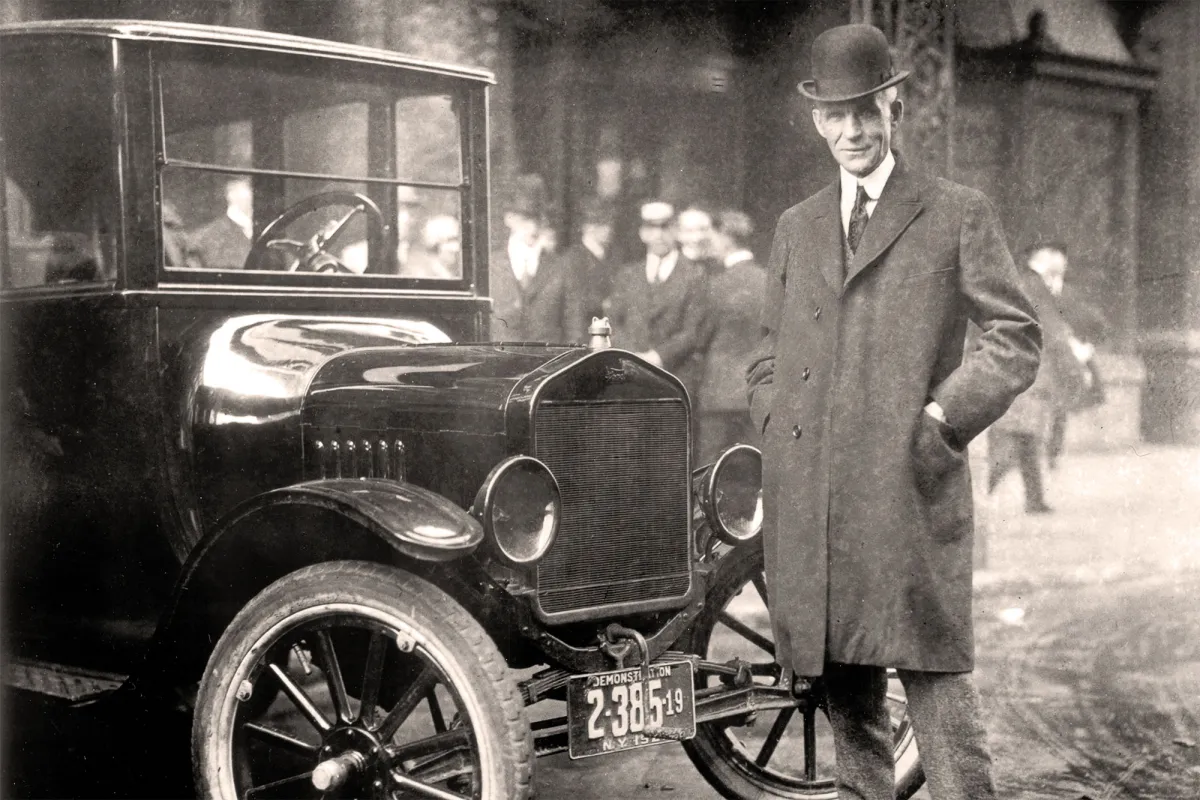 Photo: Henry Ford, via www.neh.gov
What's fascinating is how this emergency compromise gradually transformed into accepted wisdom about human productivity. By the mid-20th century, the eight-hour day had become so embedded in American work culture that we stopped questioning whether it actually made sense for the kind of work most people were doing.
Your Brain's Real Operating System
Here's where it gets interesting. While we've been faithfully clocking eight hours, researchers have been studying how human attention and cognitive performance actually work. The results are pretty much the opposite of what the traditional workday assumes.
Studies on deep work—the kind of focused, high-value thinking that drives most modern careers—consistently show that even highly trained professionals max out at around four to six hours of genuine concentration per day. Not eight. Not even close.
Researchers at DeskTime analyzed the habits of the most productive people using their software and found something striking: the top 10% of productive users worked for an average of 52 minutes, then took 17-minute breaks. They weren't grinding through eight-hour marathons—they were sprinting in short bursts.
The Afternoon Energy Crash Nobody Talks About
Your body has been trying to tell you something that your work schedule ignores. Most people experience a natural dip in alertness between 1 PM and 3 PM, regardless of whether they ate lunch. This isn't laziness or poor time management—it's your circadian rhythm doing exactly what it's supposed to do.
In cultures where afternoon naps are normal, this dip is seen as natural. In America, we've decided it's a character flaw to be overcome with more coffee.
Meanwhile, research from NASA found that a 26-minute nap improved pilot performance by 34% and alertness by 100%. But try explaining that to your boss when you're caught dozing at 2 PM.
The Productivity Paradox
Here's the part that should make every manager rethink everything: longer hours consistently correlate with lower productivity per hour. Stanford economist John Pencavel studied this extensively and found that output per hour declines sharply after 50 hours per week, and drops off so dramatically after 55 hours that working 70 hours produces barely more total output than working 55.
Yet we're still structuring work around an eight-hour standard that assumes consistent output throughout the day. It's like designing a car based on how horses behave.
Why the Myth Persists
So why hasn't this changed? Part of it is simple inertia—the eight-hour day is baked into labor laws, payroll systems, and cultural expectations. But there's also a deeper issue: we've confused time spent with value created.
In factory work, this equation made sense. More hours usually meant more widgets. But knowledge work doesn't scale the same way. A programmer who solves a complex problem in two hours of focused work creates more value than one who struggles with the same problem for eight hours while checking email and attending meetings.
The eight-hour day also serves as a convenient management tool. It's much easier to measure time than to measure actual output, especially for complex cognitive work. Showing up from 9 to 5 feels like a concrete standard, even when it has nothing to do with results.
The Real Schedule Your Brain Wants
What would work look like if we actually followed the science? Probably shorter intense work periods with real breaks, flexible scheduling that acknowledges individual chronotypes (some people really are morning people, others peak in the evening), and a focus on output rather than input.
Some companies are already experimenting with four-day work weeks and seeing productivity stay flat or even increase. Microsoft Japan reported a 40% productivity boost when they tried it. Iceland ran the world's largest trial of reduced working hours and found that productivity either stayed the same or improved in most workplaces.
The Bottom Line
The eight-hour workday solved a real problem in 1886—it literally saved lives. But we're not working in 19th-century factories anymore. We're trying to do creative, cognitive work using an industrial schedule designed for a completely different type of labor.
Your brain has been trying to tell you this for years. That afternoon slump, the way your best ideas come in the shower or during walks, the fact that you can get more done in two hours of uninterrupted focus than in a full day of meetings—none of this is a personal failing. It's your cognitive system operating exactly as designed.
The eight-hour day was never about optimizing human performance. It was about basic human dignity. The question is: what would a schedule designed for how our brains actually work look like? And why are we still afraid to find out?