The Left-Brain/Right-Brain Theory Shaped How Millions of Americans See Themselves—Neuroscientists Have Been Trying to Correct It for Years
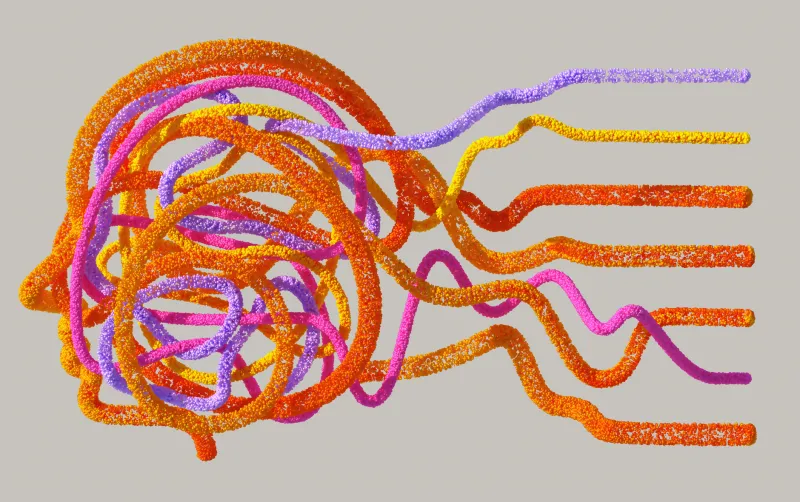
At some point in your life, someone probably told you whether you were a left-brain or right-brain person. Maybe it was a teacher explaining why you struggled with math. Maybe it was a personality quiz at a corporate retreat. Maybe it was a career counselor suggesting you were naturally wired for the arts or for analytics.
The framework feels intuitive. Logical, analytical, detail-oriented? Left brain. Creative, intuitive, big-picture? Right brain. It's clean, it's memorable, and it gives people a satisfying explanation for who they are and what they're good at.
The only problem is that it's not how the brain actually works. And the scientists whose research got turned into this pop psychology framework have spent years trying to walk it back.
Where the Theory Actually Came From
The origin story is real and genuinely interesting—it just got dramatically oversimplified somewhere along the way.
In the 1960s, neuroscientist Roger Sperry and his colleagues conducted a series of experiments on patients who had undergone a procedure called corpus callosotomy—a surgery that cuts the bundle of nerve fibers connecting the brain's two hemispheres, sometimes performed to reduce severe epileptic seizures. These were called "split-brain" patients, and studying them allowed researchers to test each hemisphere somewhat independently.
What they found was legitimately groundbreaking. The left hemisphere did appear to be more involved in language processing and certain kinds of sequential reasoning. The right hemisphere seemed more engaged with spatial tasks and pattern recognition. Sperry eventually won the Nobel Prize in Physiology or Medicine in 1981 for this work.
But here's what happened next: science communicators, self-help authors, and educators took findings from patients with surgically severed brain connections and extrapolated them into a universal theory of human personality and creativity. That leap was not supported by the research. Sperry himself was reportedly uncomfortable with how his work was being interpreted and applied.
What Brain Imaging Actually Shows
The emergence of functional MRI technology in the 1990s gave neuroscientists the ability to watch living, healthy brains in action with a level of detail that wasn't previously possible. And what they found was not a story of two separate, specialized processing centers operating independently.
A landmark 2013 study from the University of Utah analyzed brain scans from more than 1,000 people and looked specifically for evidence that individuals consistently show stronger activation on one side of the brain. The researchers found essentially no support for the idea that people are meaningfully "left-brained" or "right-brained" in any consistent, personality-defining way. Both hemispheres were active across a wide range of tasks, and the degree of lateralization—meaning how much one side dominated over the other—varied by task, not by person type.
Neuroscientist Kara Federmeier, who studies language and cognition, has explained it this way: the two hemispheres do have different tendencies, but those differences are subtle, context-dependent, and nowhere near the clean split that pop psychology describes. More importantly, the hemispheres are in constant communication with each other through the corpus callosum—the very structure that Sperry's split-brain patients had severed. In a typical, intact brain, the two sides are so thoroughly integrated that trying to assign "creativity" to one and "logic" to the other is a bit like trying to assign the melody of a song to your left ear and the rhythm to your right.
Creativity, it turns out, involves extensive networks across both hemispheres—including regions associated with memory, emotional processing, executive function, and sensory integration. So does mathematical reasoning. So does almost every complex cognitive task a human being performs.
Why the Myth Refused to Die
If the scientific community has been pushing back on this framework for decades, why does it still show up in workplace personality assessments, educational theory, and self-help content?
A few reasons. First, the original theory arrived at exactly the right cultural moment. The 1960s and 1970s were a period when Americans were hungry for frameworks that validated different kinds of intelligence—particularly creative and artistic intelligence that traditional academic culture had often dismissed. The right-brain label gave legitimacy to people who felt like outsiders in logical, analytical environments. That emotional resonance made the idea sticky in ways that a scientific correction rarely is.
Second, the framework is genuinely useful as a shorthand, even if it's wrong as a biological description. Saying "I'm more of a right-brain thinker" communicates something real about a person's cognitive style preferences—it's just that those preferences aren't actually determined by hemispheric dominance. The map got confused with the territory.
Third, industries built around the concept have a vested interest in its continuation. Tests, training programs, educational products, and personality assessments have been designed around left-brain/right-brain distinctions. Acknowledging that the foundation is shaky is not good for business.
The Identity Problem
There's a subtler consequence worth naming. When people internalize the left-brain/right-brain framework as a description of who they are, it can become a ceiling.
Students who are told they're "left-brained" may avoid creative pursuits because they've accepted a story about their own limitations. People who identify as "right-brained" may opt out of technical fields before discovering whether they'd actually enjoy them. Employers have used the framework to sort candidates in ways that have no neurological basis.
The real neuroscience suggests something more expansive: the brain is remarkably plastic, capable of developing new connections and capabilities across a lifetime, and not fundamentally divided into a creative half and a logical half. Most complex human endeavors—including both artistic creation and scientific problem-solving—require the whole thing.
The Takeaway
The left-brain/right-brain theory was built on real science that got stretched far beyond what the evidence supported. Modern neuroimaging has made it fairly clear that the brain doesn't divide its labor the way the pop psychology version claims. The hemispheres cooperate constantly, creativity and logic are both distributed processes, and no one is hardwired to be one type of thinker. If you've spent years believing you're not a "creative person" or not a "logical person" because of which half of your brain supposedly runs the show—the neuroscience says you might want to revisit that assumption.