When Is an Emergency Actually an Emergency? The Answer Costs Americans Billions a Year
The Waiting Room Full of People Who Aren't Having Emergencies
If you've spent a Tuesday night sitting in a hospital emergency room waiting to be seen for a sprained ankle, you've noticed something strange: almost nobody around you looks like they're in immediate danger of dying. There's a guy with a cough. A woman holding an ice pack to her knee. A teenager whose mom is pretty sure he might have strep.
None of them are wrong to want medical attention. But a significant number of them are in the wrong place to get it.
Studies consistently show that somewhere between 13 and 27 percent of emergency room visits in the United States involve conditions that could have been handled at an urgent care clinic, a telehealth appointment, or even a quick conversation with a nurse hotline. The Advisory Board, a healthcare research organization, has estimated that mismatched ER visits cost the American healthcare system upward of $32 billion annually. That number doesn't include what it costs the patients themselves — in time, in copays, and in the anxiety of sitting under fluorescent lights for four hours waiting to hear that you're fine.
So why does it keep happening? Partly because the line between "emergency" and "not an emergency" is genuinely blurry. And partly because the institutions that could clarify it have limited financial incentive to do so.
What Triage Nurses Are Actually Thinking
Every emergency department uses a system called triage — a rapid assessment process that sorts incoming patients by urgency. In the United States, most hospitals follow the Emergency Severity Index, a five-level scale that ranges from immediate life threats down to conditions that can safely wait hours for treatment.
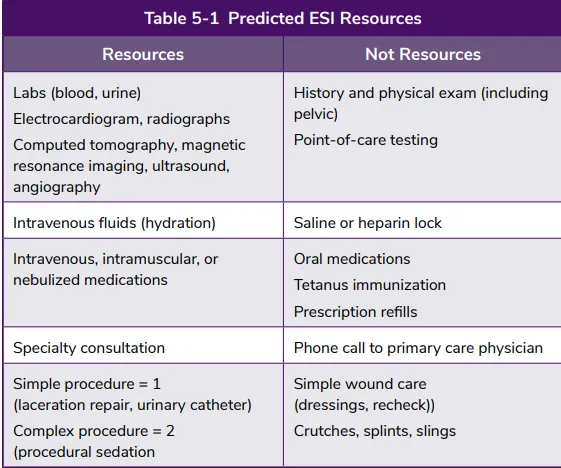 Photo: Emergency Severity Index, via nursingcecentral.com
Nurses who work triage have seen enough to develop a quiet but consistent frustration. Not with the patients themselves — most people genuinely don't know the difference — but with a system that gives patients no good way to assess their own situation before they arrive.
The conditions that reliably belong in an emergency room are narrower than most people assume. Chest pain with shortness of breath. Signs of stroke — sudden facial drooping, arm weakness, slurred speech. Severe allergic reactions. Uncontrolled bleeding. High fever in an infant under three months old. Head injuries with loss of consciousness. Difficulty breathing that doesn't improve. Suspected broken bones with significant deformity or loss of circulation.
The conditions that probably don't require an emergency room — but that show up there constantly — include ear infections, urinary tract infections, minor cuts that need a few stitches, mild asthma episodes that respond to an inhaler, sprains, low-grade fevers in otherwise healthy adults, and upper respiratory symptoms that have been going on for a week.
This isn't a judgment about the people seeking care. It's a structural problem. Most Americans were never taught the difference, and the system doesn't exactly advertise it.
Why Hospitals Don't Clarify the Line
Here's where the story gets a little uncomfortable.
Hospitals are legally required to evaluate and stabilize anyone who walks through an emergency department door, regardless of their ability to pay. That law — the Emergency Medical Treatment and Labor Act, passed in 1986 — was designed to prevent patient dumping and ensure that nobody gets turned away from critical care. It's an important protection.
 Photo: Emergency Medical Treatment and Labor Act, via thumbs.dreamstime.com
But it also means that emergency departments have become the default safety net for people who lack primary care access, who can't get a same-day appointment with their doctor, who don't have insurance, or who simply don't know where else to go at 11 PM on a Sunday.
For hospital systems, that volume isn't entirely unwelcome. Emergency departments generate significant revenue. A visit for a condition that urgent care could handle in 20 minutes might still result in several hundred dollars in facility fees, lab work, and imaging — billed at emergency rates. There's no particular financial incentive for a hospital to post a sign in its lobby saying "honestly, this could probably wait until morning."
Urgent care centers have expanded dramatically over the past decade, and many are now open evenings and weekends. Retail health clinics inside pharmacies handle a growing list of common conditions. Telehealth platforms can connect patients with a licensed provider in under 15 minutes for a fraction of the cost. These options exist and work well for a wide range of non-emergency situations. But awareness of them is uneven, and trust in them is still developing.
The Real Cost of Getting This Wrong
Using the ER when you don't need to isn't just a financial issue — it has real consequences for people who do need it.
Every patient triaged as a lower-priority case is someone occupying space, nursing attention, and administrative bandwidth. Emergency department overcrowding is a documented crisis in American hospitals, and it's directly linked to worse outcomes for high-acuity patients — people having heart attacks and strokes who need immediate intervention and sometimes wait longer because the department is backed up with lower-severity cases.
At the same time, there's a real danger in the opposite direction. People who downplay symptoms and avoid the ER when they should go end up in worse condition than if they'd gone earlier. The goal isn't to discourage anyone from seeking care — it's to seek the right care in the right place.
A Practical Framework for the Next Time You're Not Sure
The clearest guidance comes from emergency medicine professionals themselves. If any of the following are present, go to the ER: chest pain, trouble breathing, signs of stroke, severe abdominal pain, uncontrolled bleeding, loss of consciousness, or any situation that feels like it could become life-threatening quickly.
For everything else — the sore throat, the sprained wrist, the UTI, the sinus infection — an urgent care clinic, a telehealth visit, or a nurse advice line (many insurance plans offer one free, 24 hours a day) is almost always a faster, cheaper, and equally effective option.
Knowing the difference isn't about being tough or saving money. It's about getting the right care faster — and making sure the people who genuinely need emergency medicine can access it without waiting behind a waiting room full of people who didn't know there was somewhere better to go.